How Do Wallets Work? A Beginner's Guide to Crypto Wallets
How Do Wallets Work?
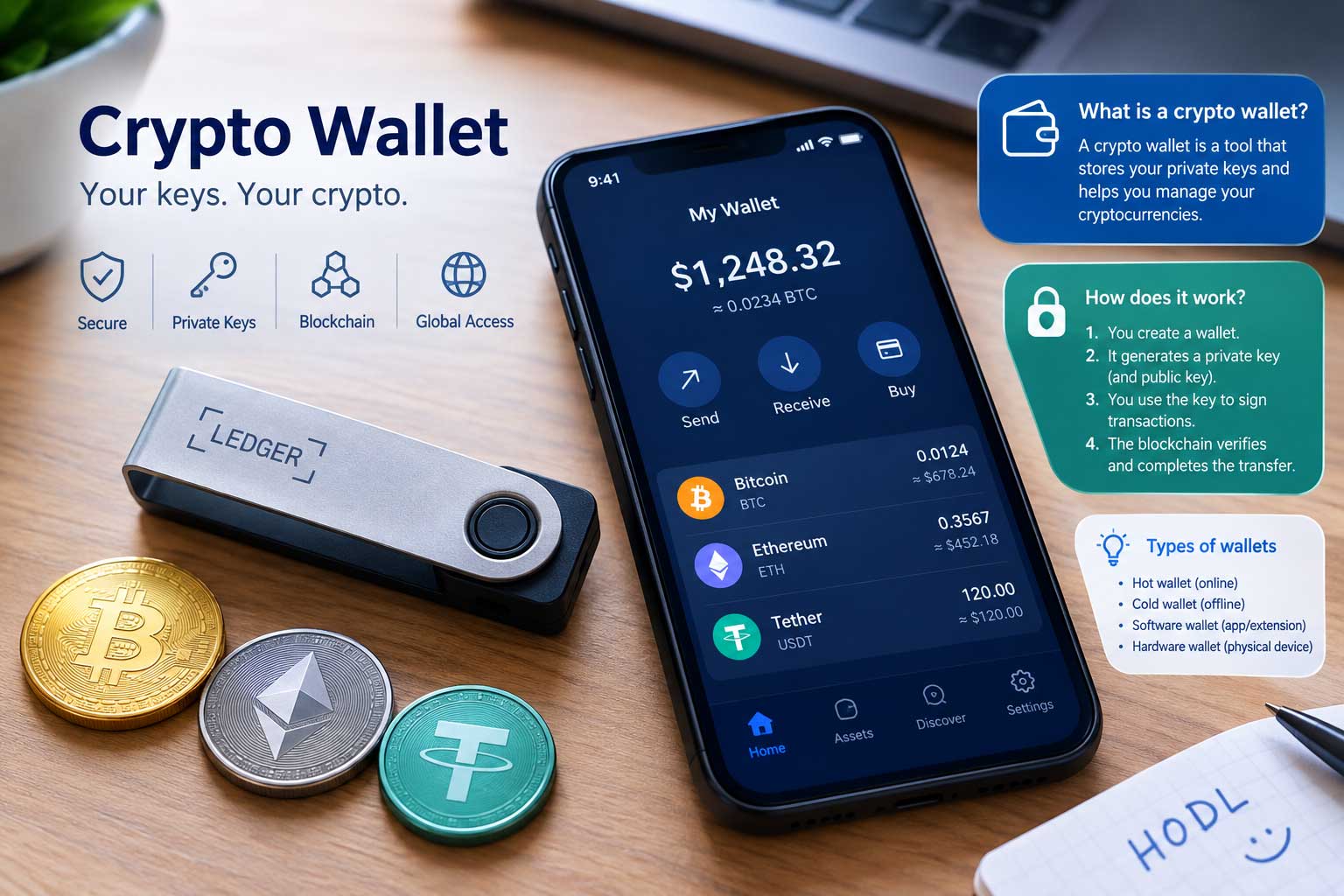
If you are new to Bitcoin or cryptocurrency, you may think a crypto wallet works like a physical wallet that stores coins. It actually works differently.
A crypto wallet does not normally store your Bitcoin inside the app or device. Your Bitcoin exists as records on the blockchain, while the wallet manages the private keys that allow you to control those funds.
For beginners in Vietnam, the easiest way to understand a crypto wallet is:
Your wallet manages your keys. The blockchain records your crypto.
Once you understand this idea, terms such as Bitcoin address, private key, seed phrase, hot wallet and cold wallet become much easier to understand.
1. What Is a Crypto Wallet?
A crypto wallet is software or hardware that allows you to manage cryptocurrency.
Depending on the type of wallet, you can use it to:
Receive Bitcoin and other cryptocurrencies
Send cryptocurrency
Check your balance
Sign transactions
Manage your private keys
Restore your wallet using a recovery phrase
Bitcoin.org describes a Bitcoin wallet as an application that manages the private keys needed to spend Bitcoin. The actual Bitcoin remains recorded on the blockchain.
A simple example
Imagine that someone sends you 0.01 BTC.
The 0.01 BTC does not physically enter your phone.
Instead:
A Bitcoin transaction is broadcast to the network.
The transaction is recorded on the Bitcoin blockchain.
Your wallet identifies the funds associated with your address.
Your wallet uses your private key when you want to spend those funds.
This is why losing your phone does not necessarily mean losing your Bitcoin. If you have a properly backed-up recovery phrase, you may be able to restore the wallet on another compatible device.
2. How Does a Crypto Wallet Work?
The process can be simplified into four main parts:
Wallet → Address → Blockchain → Private Key
| Component | What It Does | Beginner Explanation |
|---|---|---|
| Wallet | Manages your keys and transactions | Your crypto management tool |
| Address | Receives cryptocurrency | Similar to an account/payment address |
| Blockchain | Records transactions | The public transaction ledger |
| Private key | Authorizes spending | The secret key controlling your funds |
| Recovery phrase | Helps restore a wallet | Backup for your wallet |
The Bitcoin blockchain is a shared public ledger. Confirmed transactions are recorded there, while cryptography allows the network to verify who is authorized to spend the associated funds.
3. What Is a Bitcoin Address?
A Bitcoin address is the information you normally give someone when you want to receive BTC.
For example, if you want a friend in Vietnam to send you Bitcoin, you can provide your receiving address or QR code.
The basic process looks like this:
Your Wallet → Bitcoin Address → Sender → Bitcoin Network → Your Wallet
A Bitcoin address is similar to an email address in the sense that you can give it to someone so they can send something to you. Bitcoin.org recommends using addresses appropriately for privacy rather than treating one address as a permanent public identity.
Important
A receiving address can generally be shared.
Your private key and recovery phrase must never be shared.
| Information | Can You Share It? | Purpose |
|---|---|---|
| Bitcoin address | Yes | Receive BTC |
| QR code for receiving BTC | Yes | Convenient way to share an address |
| Public key | Generally public | Used in cryptographic systems |
| Private key | Never | Authorizes spending |
| Recovery/seed phrase | Never | Restores wallet access |
4. What Is a Private Key?
A private key is a secret piece of cryptographic information that gives you the ability to authorize transactions from a Bitcoin wallet.
You can think of it as the master secret behind your Bitcoin wallet.
If someone obtains your private key, they may be able to control the associated funds.
This is why Bitcoin self-custody comes with responsibility. There is normally no bank that can simply reset your private key after you give it to a scammer.
Bitcoin.org explains that private keys provide the cryptographic proof required to spend Bitcoin from a wallet.
Never share your private key
No legitimate:
Exchange employee
Wallet support agent
Telegram administrator
Facebook administrator
Zalo contact
"Crypto recovery expert"
should ask you to send your private key.
5. What Is a Seed Phrase?
A seed phrase, also called a recovery phrase, is a series of words that can be used to restore a compatible cryptocurrency wallet.
Many modern wallets use a recovery phrase as a backup mechanism. Bitcoin.org notes that a recovery phrase can restore a wallet and should be kept securely offline.
For example, a wallet might generate a phrase containing 12 or 24 words.
Do not treat these words like a normal password.
They can potentially provide access to your wallet.
How should you store a seed phrase?
For a beginner:
| Method | Recommendation |
|---|---|
| Write on paper | Suitable if stored securely |
| Metal backup | Better for long-term physical storage |
| Screenshot on phone | Avoid |
| Save in Google Drive | Avoid |
| Send to yourself on Zalo | Never |
| Send by email | Avoid |
| Store in password manager | Depends on your security setup; beginners should understand the risks first |
Bitcoin.org specifically recommends keeping recovery information securely offline and warns against storing recovery phrases as photos or in cloud services.
6. What Happens When You Send Bitcoin?
Suppose you want to send 0.005 BTC to another person.
The process is roughly:
Step 1: Enter the recipient's address
You paste or scan the recipient's Bitcoin address.
Step 2: Enter the amount
You specify how much BTC you want to send.
Step 3: Your wallet creates a transaction
The wallet uses your private key to digitally sign the transaction.
Step 4: The transaction is broadcast
The transaction is sent to the Bitcoin network.
Step 5: The network verifies it
Bitcoin nodes check whether the transaction follows the network's rules and whether the funds can be spent.
Step 6: The transaction is confirmed
Transactions that are included in blocks become part of the Bitcoin blockchain.
The important point is:
Your wallet does not physically move coins from your phone to another phone. It creates and authorizes a blockchain transaction.
7. What Happens When Someone Sends You Bitcoin?
Receiving Bitcoin is easier.
For example, if you buy BTC from an exchange in Vietnam and want to move it to your personal wallet:
Open your wallet.
Select Bitcoin.
Choose Receive.
Copy your BTC address or display the QR code.
Open the exchange withdrawal page.
Paste or scan your wallet address.
Select the correct Bitcoin network.
Check the amount and withdrawal fee.
Confirm the withdrawal.
Wait for the transaction to be processed and confirmed.
Always check the network
This is especially important for beginners.
Do not assume that every cryptocurrency address can receive every type of token.
Before confirming a withdrawal, check:
| Check | Why It Matters |
|---|---|
| Asset | Make sure you are sending BTC |
| Network | Make sure the sending and receiving networks are compatible |
| Address | One wrong character can cause serious problems |
| Amount | Check the BTC amount |
| Fee | Check the exchange's withdrawal fee |
| Destination | Confirm that the address belongs to you |
For a large transfer, making a small test transaction first can be a sensible precaution.
8. Hot Wallet vs Cold Wallet
One of the most important wallet concepts for beginners is the difference between hot and cold wallets.
A hot wallet is connected to the internet, such as a mobile or desktop wallet.
A cold wallet keeps the private keys offline, commonly through a hardware wallet.
| Feature | Hot Wallet | Cold Wallet |
|---|---|---|
| Internet connection | Usually connected | Private keys kept offline |
| Convenience | High | Medium |
| Daily payments | Good | Less convenient |
| Long-term storage | Depends on risk/amount | Common choice |
| Typical example | Mobile wallet | Hardware wallet |
| Main risk | Online attacks, phishing, malware | Physical loss, recovery mistakes |
There is no need for a beginner to choose only one type.
Some users keep a small amount in a hot wallet for everyday transactions and use cold storage for larger long-term holdings.
9. Custodial Wallet vs Self-Custody Wallet
Another important distinction is who controls the private keys.
Custodial wallet
With a custodial service, such as an exchange account, the platform generally controls the private keys on your behalf.
This can be convenient for beginners.
However, you depend on the platform's security, availability and withdrawal policies.
Self-custody wallet
With self-custody, you control the private keys.
This gives you more direct control over your cryptocurrency, but also more responsibility.
| Feature | Custodial | Self-Custody |
|---|---|---|
| Private keys | Controlled by service | Controlled by you |
| Convenience | High | Medium |
| Recovery | Usually account-based | Recovery phrase/private key |
| Main risk | Platform/counterparty risk | User error/key loss |
| Beginner-friendly | Usually easier | Requires more responsibility |
| Example | Exchange account | Personal wallet |
Bitcoin.org describes self-custody as controlling your own funds through your private keys rather than relying on a custodian.
10. How Vietnamese Beginners Usually Use Wallets
For someone in Vietnam who is just starting with crypto, you do not need to buy an expensive hardware wallet immediately.
A simple learning path can be:
Beginner stage
VND → Exchange → Buy BTC/USDT → Learn how withdrawals work
At this stage, the exchange account is often easier because you do not have to manage a seed phrase immediately.
Next stage
Exchange → Mobile/Desktop wallet → Small BTC transfer
Use a small amount to learn:
Receiving BTC
Sending BTC
Checking transaction status
Paying network/exchange withdrawal fees
Backing up a wallet
Long-term stage
If your BTC holdings become significant and you plan to hold them for a long time, you can research hardware wallets and self-custody.
The goal is not simply to "move everything off an exchange." The goal is to understand the security responsibilities before taking custody yourself.
11. Common Wallet Mistakes Beginners Should Avoid
Vietnamese crypto beginners should be especially careful with social-media and messaging-app scams.
Mistake 1: Sharing your seed phrase
Never share it.
If somebody asks for your 12/24-word recovery phrase to "verify your wallet", treat it as a major warning sign.
Mistake 2: Keeping a seed phrase as a screenshot
A screenshot may be synchronized to cloud services or exposed if your phone or account is compromised.
Mistake 3: Clicking a fake wallet website
Scammers may create websites that look almost identical to legitimate wallet services.
Download wallet software from the project's official website or trusted app store and verify the source.
Mistake 4: Sending BTC to the wrong address
Bitcoin transactions generally cannot simply be reversed like a bank transfer.
Always check the receiving address before confirming.
Mistake 5: Storing everything in one place
A single backup location creates a single point of failure.
Bitcoin.org recommends considering multiple secure physical locations for backups.
Mistake 6: Thinking the wallet stores the BTC
Your BTC is recorded on the blockchain.
The wallet manages the keys that allow you to control the associated funds.
12. How Much Bitcoin Should You Keep in a Wallet?
There is no universal amount that every beginner should keep in a particular wallet.
Instead, consider the purpose.
| Situation | Possible Approach |
|---|---|
| Learning crypto | Start with a small amount |
| Everyday spending | Hot wallet may be convenient |
| Long-term savings | Consider cold storage |
| Large BTC holdings | Consider stronger self-custody practices |
| Still learning seed phrases | Do not rush into large transfers |
The important lesson is that wallet security should match the value and purpose of your holdings.
13. Is a Crypto Wallet Safe?
A wallet can be secure, but there is no wallet that automatically protects you from every risk.
The biggest risks for beginners often include:
Phishing
Fake wallet applications
Fake customer support
Seed phrase theft
Malware
Weak passwords
SIM or email account compromise
Sending funds to the wrong address
Bitcoin.org notes that user mistakes are among the common weak points in Bitcoin security and recommends strong security practices, backups and caution with online services.
For Vietnamese users, be particularly careful with unsolicited messages on Zalo, Facebook, Telegram and other social platforms claiming to offer wallet support or account recovery.
14. Crypto Wallets and Vietnam's Regulatory Environment
A crypto wallet is a technical tool for managing cryptographic keys, but using cryptocurrency in Vietnam also involves an evolving regulatory environment.
Vietnam established a five-year pilot framework for the crypto-asset market under Resolution 05/2025/NQ-CP. The framework provides for domestic investors to use licensed crypto-asset service providers for custody, buying and selling within the regulated market.
Vietnam also issued Decree 284/2026/NĐ-CP, effective September 1, 2026, covering administrative penalties related to crypto assets and the crypto-asset market.
For beginners, this means two things should be kept separate:
How a wallet technically works
Which crypto services and transactions are permitted under current Vietnamese regulations
The technology of a Bitcoin wallet is global, while the rules governing exchanges and crypto-asset services can vary by country.
15. Frequently Asked Questions
Does a crypto wallet actually store Bitcoin?
No. Bitcoin exists as records on the Bitcoin blockchain. A wallet manages the private keys used to control and spend the associated funds.
What happens if I lose my phone?
If your wallet has been properly backed up and supports recovery through a recovery phrase, you may be able to restore it on another compatible device.
The recovery phrase is therefore extremely important.
Can someone steal Bitcoin with my wallet address?
A Bitcoin address by itself is normally used for receiving funds and does not give someone your private key.
The major secret is your private key or recovery phrase.
Can I have more than one crypto wallet?
Yes. You can use multiple wallets. For example, you could use one wallet for everyday transactions and another for long-term storage.
Is a hardware wallet necessary for beginners?
Not necessarily.
If you are only learning how Bitcoin works or holding a small amount, a reputable software wallet or exchange account may be sufficient for learning.
As the amount you hold increases, you may want to learn about cold storage and hardware wallets.
What is the difference between a wallet address and a seed phrase?
A wallet address is normally shared when receiving cryptocurrency.
A seed phrase is a private backup that can restore wallet access.
Address = can be shared.
Seed phrase = must remain secret.
Can an exchange be considered my wallet?
An exchange account can provide custodial crypto storage, but it is different from a self-custody wallet.
With custodial storage, the exchange controls the private keys. With self-custody, you control them.
Conclusion
Crypto wallets may seem complicated at first, but the basic concept is simple:
The blockchain records your Bitcoin.
Your wallet manages your keys.
Your address lets people send you Bitcoin.
Your private key authorizes spending.
Your seed phrase can restore your wallet.
For beginners in Vietnam, start small and learn the basics before moving large amounts of BTC into self-custody.
The most important wallet rule is also the simplest:
Never share your private key or recovery phrase with anyone.